

When parents start researching sleep solutions, they often come across terms like “gentle sleep training,” “responsive sleep training,” “fading,” and “no-cry methods.” In my experience, there seems to be a lot of confusion about what these methods actually mean and what one can expect when implementing them.
As a Vancouver sleep consultant, when I am meeting a client for the first time on our discovery call, my intention is always to be transparent about what sleep training actually is and what the difference is between “gentle” and “no cry.” The intention is never to convince someone they should sleep train and to paint a picture that is not based in reality. Sleep training is not for everyone and the last thing that I want for my clients is to first discover that once we already begin to work together.
One parenting choice around sleep does not mean the other is wrong or bad. I truly respect every family’s right to make choices that align with their parenting philosophy and comfort level. For some, this means they are not comfortable with any level of crying or frustration and for these families, sleep training just isn’t the right option for them.
I classify my approach as gentle sleep training due to the fact that I make sure that everything WE can control that will make the process as easy as possible for baby is being taken into account. As I always say, half, if not more, of sleep training is not about the method. Sleep pressure, the circadian rhythm, feedings, environment and routines have an enormous influence on how fast a baby catches onto the sleep training and how much frustration they experience.
That being said, the fact of the matter is, most sleep training will be met with frustration from the baby in the first few days where everything is new and being established. Babies love what they know. They love the routines and habits that they know, just as most adults do. Let’s face it, who actually truly enjoys big changes. For most humans, it’s uncomfortable, even when it’s the best thing for us and always requires an adjustment period.
When we make a change and replace those habits, babies are often frustrated. This is something we can’t control and if we continue to offer the previous associations and habits, those ones will be the ones that remain. Babies can only communicate through crying but the intention of gentle sleep training is to keep that crying to as minimal as possible by creating those optimal conditions.
What Is Gentle Sleep Training?
Defining Gentle Sleep Training
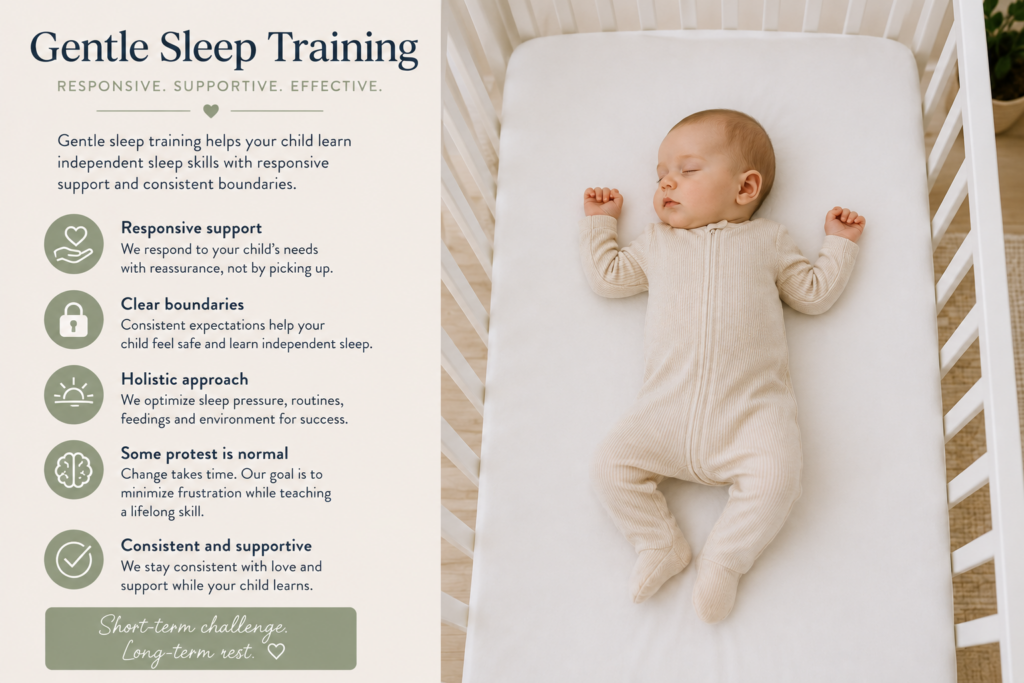
Gentle sleep training focuses on helping children learn independent sleep skills while maintaining responsive, supportive parent involvement throughout the process.
Now, the biggest distinction though between “gentle sleep training” and “no cry” is where the most confusion and misconception occurs. I believe this is where expectations are sometimes not aligned.
When using any sleep training method, the way a child learns to fall asleep independently is by doing. They go from awake to asleep and the more times they practice this, the less frustration there is. Gentle sleep training does not mean we continue to provide the sleep associations that the baby knows and that we directly help them to sleep. This is why there is still protest in gentle sleep training, even with a highly responsive method.
At the end of the day, the thing that truly fully erases the frustration is being picked up, rocked to sleep or fed to sleep.
However, this response will continue to reinforce the previous habits, often actually reinforcing longer and longer protests and not learning the skill of independent sleep.
Long story short: gentle, highly responsive methods, in order for them to truly teach the skill of independent sleep, will still involve protest. However, we are still responsive and we are also approaching sleep holistically.
Key Characteristics
- Parents remain responsive to their child’s needs
- Crying is responded to through reassurance but not through picking up or being helped to sleep
- Sleep associations are reduced or taken away
- Clear boundaries and consistency are provided
- Sleep is approached holistically through appropriate sleep pressure, environment, feedings and routines
Common Gentle Sleep Training Methods
- Chair method
- Check-and-console approaches
- Camping out
- Responsive interval methods
- Gradual withdrawal
What Are No-Cry or Fading Approaches?
Defining Fading Methods
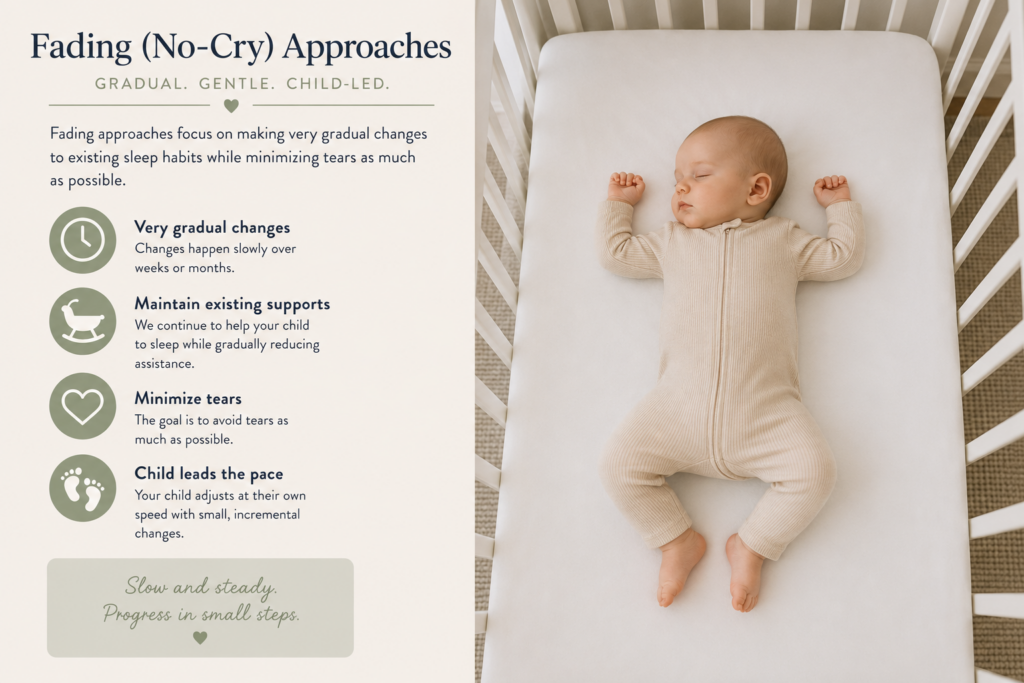
Fading approaches aim to improve sleep by making very small, gradual changes to existing sleep habits while minimizing or avoiding tears altogether.
The idea behind fading approaches is not to remove the reinforcement of being helped cold turkey. It’s to replace stronger sleep associations with weaker ones while always still providing assistance to sleep.
The biggest difference between “no cry” and “gentle sleep training” is the speed at which one removes sleep associations and the efficiency of the process. Sleep training involves removing the reinforcement of the previous habits on night one and replacing them with a change in response from the parent.
“No cry” still very much involves the parent directly putting and helping the baby to sleep. Now, in my experience, this actually doesn’t always get met with no tears as babies also like what they know. They don’t always accept, for instance, being rocked to sleep versus nursed to sleep.
The time it takes to see progress is vastly different between sleep training and fading approaches and can be highly influenced by the baby’s temperament. Sleep training provides fast and efficient results, usually over the span of 2 weeks with significant progress already occurring after 4–7 days.
Fading approaches on the other hand can take months to implement successfully. They also require an even higher level of commitment and consistency to see progress and the implementation is much more nuanced than sleep training. Some babies also don’t respond well to fading approaches as they hold out for their preferred sleep association. This causes parents to become frustrated and give up.
Many times, when parents are needing a change, they are already running on months of broken sleep and don’t have the patience or energy to implement changes slowly. They are looking for faster and meaningful results.
Key Characteristics
- Changes occur very slowly over months
- Parents maintain existing sleep supports through rocking or feeding
- Crying is minimized as much as possible
- Sleep associations are gradually faded over time
- The child leads much of the pace
Common Fading Techniques
- Reducing rocking time incrementally
- Gradually moving away from the crib
- Slowly decreasing feeding support and replacing it with another sleep association
- Delaying parental responses by very small amounts
- Shush/pat method
- Bedtime fading
What About Crying?
Gentle Sleep Training and Crying
Even the gentlest sleep training methods usually involve some frustration, protest, or tears as children adapt to a new routine or expectation. Change is frustrating and the only way a baby can communicate this frustration is through crying. This of course only applies to crying in relation to the change. Sleep training never means ignoring crying related to a legitimate need.
The goal is not to eliminate crying completely but to respond supportively while maintaining consistency and also not reinforcing previous habits. Babies are incredibly smart and understand the relationship between their behaviour and parental response. If a baby learns quickly that longer protest leads to mixed responses/previous habits, protest can continue to escalate instead of decrease.
To learn more about sleep training and crying, check out this post.
No-Cry Approaches and Crying
No-cry methods aim to minimize crying as much as possible by still helping a baby or child to sleep if needed and providing those associations. However, it’s important to recognize that some children may still protest changes, even when those changes are introduced very gradually.
How Long Does Each Approach Take?
Gentle Sleep Training
- Often produces noticeable improvements within 1–2 weeks
- Requires consistency
- Typically involves more active learning and frustration
Fading Approaches
- May take several weeks or months
- Progress can be slower but feel more comfortable for some families if they feel they are not in a rush and can be committed
- Works best when parents are able to be highly patient and consistent
Which Approach Is Right for Your Family?
Consider gentle sleep training if:
- Sleep deprivation is significantly affecting your family
- You want a structured plan
- You’re comfortable supporting your child through some frustration
- You’d like to see changes within a reasonable timeframe
Consider fading approaches if:
- You prefer making very gradual changes
- Current sleep challenges are manageable
- You have flexibility regarding timelines
- Avoiding tears is a top priority and you don’t feel comfortable with any protest
The Bottom Line
Gentle sleep training and no-cry approaches are not opposites. Both can be responsive, loving, and respectful of a child’s emotional needs.
The biggest difference lies in the pace of change and how independent sleep skills are developed. The best approach is the one that aligns with your family’s values, your child’s temperament, and the level of support your family currently needs.
When making the decision on which approach is right for your family, it’s best to be honest with yourself about your limits and comfort level. Sleep training can have a short-term period of difficulty and can be emotionally challenging. Some families choose that this short-term difficulty is worth the long-term benefits and results. Other families are simply not comfortable with any level of crying and that is completely valid as well.
It’s important too to understand what sleep training truly entails and not to confuse gentle sleep training with no cry as this can cause frustration, disappointment and false expectations.
That being said, sometimes we also don’t truly know what’s right for us until we are in the moment of trying something. It’s always ok to pivot and adapt as this parenting journey is an ongoing learning experience.
If you feel like sleep training is the right fit for you and you are looking for some support, please check out more about my philosophy or book a free consultation with me.
Teresa Sedlmair is the founder of Little Trees Sleep Consulting in Vancouver, BC. She supports families with babies and toddlers in Vancouver, across the Lower Mainland and virtually abroad. She works closely with parents to navigate challenges like night wakings, short naps, co-sleeping and various other sleep associations such as rocking and feeding to sleep using practical, evidence based and responsive approaches. She is trusted by over 600 families and has an exclusive 5 star rating.