

One of the most common questions parents ask is: When is the right time to start sleep training?
I find the answer to this question is one area of sleep training that is highly debated and even controversial. There are evidence based sleep training support groups that claim that due to no evidence supporting otherwise, it is ok to sleep train from birth. Other programs/methods equate sleep training with night weaning and draw a hard line at not starting earlier than 6 month or that one can’t sleep train during the four month sleep regression (which is not true in my experience).
This is where the answer to this question can be highly variable and anecdotal. After working with hundreds of babies, I have come to my own conclusions based on multiple reference points and patterns that I have seen.
As a baby sleep consultant in Vancouver and the founder of Little Trees Sleep Consulting, I work with many families who are unsure about when sleep training is developmentally appropriate.
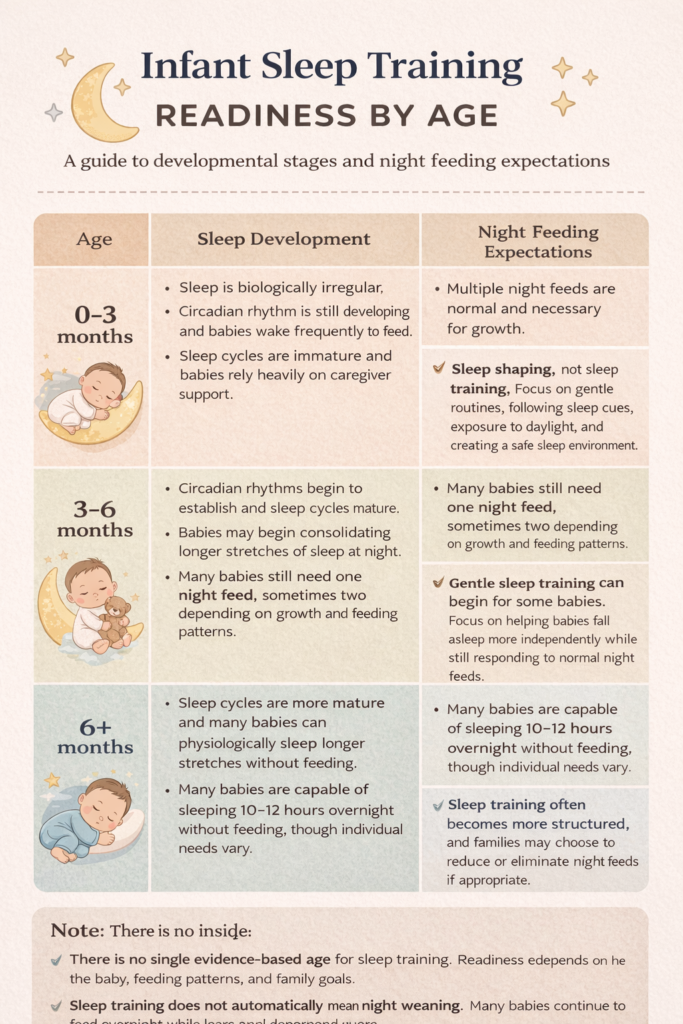
The truth is that there is no single evidence-based age at which sleep training must begin. Every baby develops at their own pace, and readiness depends on several biological and developmental factors.
In my experience, most healthy full-term babies begin to show signs of readiness for learning independent sleep skills sometime between 3 and 4 months of age. This is based on the fact that I have not seen any patterns or evidence that waiting longer than this leads to a smoother or faster sleep training experience. If anything, I actually find my younger babies often catch on very quickly. The key thing to remember is sleep training does not mean night weaning. Sleep training merely means we are teaching a baby how to fall and stay asleep independently by teaching them how to link their own sleep cycles. Night feedings are for calories and nutrition, which are still developmentally appropriate for younger babies.

Understanding Infant Sleep Development
In the first weeks of life, newborn sleep is primarily driven by feeding needs and immature circadian rhythms. Babies sleep in short stretches throughout the day and night because their internal clock has not yet developed. Melatonin output is not quite there and many babies even have their days and nights flipped. This is especially the case if they are sleeping for long periods during the day.
Over the first few months, however, babies begin developing a circadian rhythm, which is the biological clock that helps regulate sleep over a 24-hour cycle.
Research suggests that circadian rhythms begin to emerge around 8–12 weeks of age, gradually helping babies consolidate more sleep overnight (Jenni & LeBourgeois, 2006).
As this rhythm develops, babies often begin to:
- Sleep longer stretches at night
- Develop more predictable sleepy cues
- Become more responsive to consistent bedtime routines and have an easier time falling asleep at bedtime.
- Transition through more mature sleep cycles
These developmental changes are one reason some families begin exploring sleep training in the 3–4 month window. Sleep training before a circadian rhythm is developed is fighting against the biggest helper in sleep training; sleep pressure.
Why Many Families Start Sleep Training Around 3–4 Months
While there is no universally proven age to begin sleep training, many babies around this stage are developmentally capable of beginning to learn independent sleep skills.
Several factors contribute to this.
Circadian rhythms are becoming established
Around this age, babies begin producing melatonin in a more predictable pattern, helping their bodies recognize nighttime sleep. This makes bedtime routines and sleep schedules more effective.
Sleep cycles mature
Around the four-month mark, many families suddenly notice their baby waking much more frequently overnight. Parents often assume something has gone wrong, but in reality this usually reflects a normal developmental shift in sleep cycles. In my work with families, this stage is often when parents first start thinking about teaching independent sleep skills.
Infant sleep begins to shift into more adult-like cycles. Babies transition between lighter and deeper sleep stages, which is why many parents suddenly notice more night wakings around 3–4 months. Newborns going easily from light and deep sleep and only have two stage sleep cycles. Once they mature, they come more fully out of each sleep cycles. If a baby still needs something to help them fall back asleep, they are more likely to have a full waking and need to be rocked or fed back to sleep. All babies and adults have night wakings as we connect sleep cycles.
In my experience, the four month sleep regression is misnamed. It usually hits around 12-16 weeks old when babies are still technically 3 months old. When a baby is falling sleep independently already, they might bypass this regression completely as they already know how to connect their own sleep cycles.
Longer sleep stretches may begin
Many babies can begin sleeping longer stretches between feedings, though night feeds are still very common and developmentally normal. In the newborn stage, babies have very small stomachs and need frequent feedings in a 24 hour period in order to meet their caloric needs. As babies get older, they are able to meet more of their intake in fewer feedings and also throughout the day.
Sleep training does not have to mean eliminating night feeds. Before 6 months, most babies still need one night feeding at least. One can very much sleep train successfully while keeping appropriate feedings with the right method and parameters around these feedings.
I have had a lot of clients express reluctance around sleep training before a baby is ready to night wean as they believe that it won’t be successful. I have not found this to be the case for 98% of babies. My clients still gain longer stretches at night between feedings due to their baby’s being able to connect their sleep cycles. Many wakings are not hunger related.
Sleep training focuses on helping babies fall asleep independently at bedtime and return to sleep between normal wakings, while still feeding overnight when needed.
Signs Your Baby May Be Ready for Sleep Training
Because there is no single “correct” age to sleep train, it’s often more helpful to look for developmental signs of readiness.
Some babies may be ready slightly earlier or later than others.
Common readiness signs include:
- Sleeping one longer stretch of 4–6 hours at night which often signals an established rhythm.
- Establishing a clear and earlier bedtime.
- Beginning to develop more predictable naps and keep to full wake windows in the day.
- Showing clearer tired cues
- Establishing clear feeding patterns and gaining weight adequately
- Resisting usual soothing attempts and sleep associations.
- Responding well to consistent bedtime routines
Parents may also notice that their baby begins waking more frequently overnight, which can happen as sleep cycles mature. This stage is often referred to as the four-month sleep regression, though it is actually a
permanent developmental change in sleep structure.
Is Sleep Training Ever Too Early?
Most baby sleep consultants agree that formal sleep training is not appropriate during the newborn stage. This is despite the fact that no formal evidence exists. In my opinion, this feels instinctual. Just because we don’t have data stating that we shouldn’t sleep train in the newborn, doesn’t mean we should.
In the first 8–12 weeks of life, babies need frequent feeding and close responsiveness. During this period, the focus is typically on supporting healthy sleep foundations rather than structured sleep training. Our babies are brand new to this world and both mother and baby are getting to know each other, establishing feeding and recovering from birth. The focus does not need to be on independence. I find many parents who know that they are going to sleep train approach the newborn period in a very relaxed and flexible way. They just want to enjoy and cuddle their baby, This will not impact their ability to be sleep trained successfully and efficiently.
Helpful early habits may include:
- Exposure to daylight during the day
- A simple and calming bedtime routine with an appropriate bedtime
- Maintaining full wake windows in the day and capping day sleep
- Creating a safe sleep environment
These gentle foundations can make later sleep training smoother if families choose to pursue it.
A Personalized Approach to Sleep Training
Every baby is different, and there is no single sleep training approach that works for every family.
Some families prefer gradual, hands-on methods, while others choose more structured approaches. The best sleep plan is always one that considers:
- Your baby’s temperament and individual sleep needs. Not all babies have the same sleep needs in 24 hours.
- Feeding needs
- Family comfort level
- Developmental readiness
As a baby sleep consultant in Vancouver and helping clients virtually all over the world, my goal at Little Trees Sleep Consulting is to help families find an approach that feels supportive, responsive, and realistic for their unique situation.
Sleep training should never feel rigid or overwhelming. With the right guidance, it can be a gentle process that helps both babies and parents get the rest they need.
The Bottom Line
There is no single evidence-based age for sleep training, but many babies begin showing developmental readiness between 3 and 4 months of age as circadian rhythms strengthen and sleep cycles mature. The newborn stage is for both parents and baby to adjust to their new normal and being on this earth.
Sleep training also does not have to mean night weaning. Many babies continue to feed overnight while learning independent sleep skills. The decision around when to night wean is completely based on the comfort level of the parents and readiness of the baby.
By the time many families reach out for sleep support, they’re often running on very little sleep themselves. It’s common for parents to tell me they’ve been waking every hour or two for months. One of the biggest shifts I see after sleep improves isn’t just better rest for the baby—it’s the dramatic improvement in parental wellbeing.
Ultimately though, the right age to sleep train is when YOU and your baby are ready. It is also never too late to sleep train.
Teresa Sedlmair is the founder of Little Trees Sleep Consulting in Vancouver, BC. She supports families with babies and toddlers in Vancouver, across the Lower Mainland and virtually abroad. She works closely with parents to navigate challenges like night wakings, short naps, co-sleeping and various other sleep associations such as rocking and feeding to sleep using practical, evidence based and responsive approaches. She is trusted by over 600 families and has an exclusive 5 star rating.
References
Jenni, O. G., & LeBourgeois, M. K. (2006). Understanding sleep–wake behavior and sleep disorders in children. Pediatric Clinics of North America.
Mindell, J. A., Kuhn, B., Lewin, D. S., Meltzer, L. J., & Sadeh, A. (2006). Behavioral treatment of bedtime problems and night wakings in infants and young children. Sleep.
Gradisar, M., Jackson, K., Spurrier, N. J., et al. (2016). Behavioral interventions for infant sleep problems: A randomized controlled trial. Pediatrics.
Price, A. M. H., Wake, M., Ukoumunne, O. C., & Hiscock, H. (2012). Five-year follow-up of harms and benefits of behavioral infant sleep intervention. Pediatrics.