
When I have my initial consultations with my clients, the number one concern and reluctance around sleep training is (and understandably so) around the idea that their baby or toddler will cry during the process. I remember feeling the exact same way when I was learning about sleep training and making the decision that sleep training was the right fit for our family. We live in a world that is deeply uncomfortable with difficult and strong feelings. As well, as adults, we tend to interpret crying is a sign of discomfort and distress. The last thing any of us want is for our children to go through hardship. However, as we know, life is full of difficult feelings and hard moments. There are certain circumstances where our children have the capability to go through frustrating feelings, when it is for the goal of benefitting their safety, health or wellbeing.
Few topics in parenting bring up as much emotion as crying—especially when it comes to sleep. Many parents come to sleep training feeling conflicted: they’re exhausted, they know sleep matters, but they’re deeply uncomfortable with the idea of their baby crying. When I’m speaking to parents in my initial calls, my intention is never to convince someone they should or have to sleep train. Every parent is entitled to their own feelings and decisions around what choices align with their parenting philosophy and comfort level.
This post is not about convincing you that crying “doesn’t matter,” nor is it about promoting one specific sleep training method or that everybody has to sleep train. Instead, it’s meant to offer evidence‑informed, experience‑based guidance to help you think about crying in a more nuanced, compassionate way if you are feeling conflicted around the decision to sleep train.
Why Crying in Sleep Training Is Such a Sensitive Topic for Parents
Crying is designed to get our attention. It activates a biological stress response in parents—your heart rate rises, your instincts kick in, and it can feel almost impossible to stay calm. For many families, crying is quickly linked to fears about harm, abandonment, or emotional damage.
On top of that, online conversations around sleep training often live at the extremes: either sleep training is portrayed as perfectly gentle and tear‑free, or as inherently harmful. This leaves little room for the reality most families experience.
An important reframe is this: crying is communication, not a measure of parental love or responsiveness. Babies cry for many reasons, including frustration, boredom, and difficulty with transitions—not only because something is wrong. In my experience with my own children, secure attachment is formed with every loving, responsive interaction throughout every moment of each day. I can say with the utmost confidence that my children have a textbook secure attachment, even though they were both sleep trained. They know that I will always meet their needs, I will always provide comfort and love, day or night. This is the misconception around sleep training. It does not mean we shut the door and ignore our baby’s needs. It means we are holding certain boundaries around sleep to foster healthy habits while still being responsive.
Sleep training should never mean days and hours of crying. There is an initial learning period where babies and toddlers are getting the hang of the new skill and habit. However, once their confidence grows, their frustration decreases quickly.
As a trusted sleep consultant at Little Trees Sleep Consulting, I believe it is ok to let our children go through difficult feelings and hard moments. As long as we can guide them and remain physically/emotionally connected to them. A comparison I like to draw to sleep training is also to holding boundaries in the toddler years. Our toddlers need us to be sturdy leaders with clear and consistent expectations. By teaching them that we must avoid hard feelings by never holding a boundary, we are actually undermining their resilience and their ability to learn how to move through difficult feelings.
Not All Crying Is the Same
One of the most overlooked pieces of this conversation is that not all crying sounds—or means—the same thing.
There is a difference between:
- Brief protest crying versus escalating, panicked distress
- Frustration while learning a new skill versus fear or unmet physical needs
- A baby who cries loudly for two minutes and then settles versus one who becomes more dysregulated over long periods of time.
Most babies cry during transitions—getting into the car seat, leaving the bath, or winding down for sleep. Sleep is no different. What matters most is not the presence of crying, but the pattern, intensity, and how it changes over time.
Sleep is a developmental skill. Like all learning, it can come with moments of frustration. When familiar sleep associations change—being rocked less, fed earlier in the routine, or falling asleep in a different way—babies may protest. Something I have learned now after working with over 500 babies and toddlers is that like adults, babies and toddlers absolutely do not like change but when given the opportunity, they are actually so much more adaptable and capable than we give them credit for. How many times have we as adults had those moments? We drag our feet when we want to make a change that benefits us, we finally make it while experiencing a short term period of discomfort, and then we are so much happier for it.
Why Some Crying Can Happen During Sleep Training (Even With Gentle Methods)
This is why babies can protest and be frustrated even when parents are:
- Present and responsive
- Using gentle, hands‑on methods
- Supporting their baby consistently
Gentle sleep training does not guarantee silence. Instead, it aims to reduce the intensity and duration of crying over time by increasing predictability and helping babies learn new ways to settle.
To add to the that, in my experience, the number one thing that actually lets your baby settle as quickly as possible is a clear approach combined with optimal sleep pressure. If your baby is not ready for sleep, they will fight it longer.
Crying vs. Crying It Out (CIO): Understanding the Difference
Crying is a behavior. Crying it out (CIO) is a specific sleep training method.
Many approaches considered “gentle”—such as shush‑pat, Ferber, camping out, or gradual fading—can still involve some crying. Avoiding all crying often leads to unsustainable sleep habits or prolonged night wakings that result in more crying overall. So many of my clients have reported that even while rocking or soothing, their baby is still resisting and crying.
The real distinction between approaches is not whether crying occurs, but how parents respond. Responsiveness, consistency, and emotional presence matter far more than achieving a tear‑free experience.
While some clients choose CIO because they feel the checks cause more crying, I find in 99% of cases, CIO is not necessary, even for a particularly spicy temperament.
What Research Says About the Safety of Sleep Training
Concerns about crying are understandable, which is why research matters. There is so much noise out there about the impacts of sleep training. Most of this noise is anecdotal and not evidence based. Anybody on social media can make a claim that sounds like it is supported by research.
Here is what the research actually says.
Multiple peer‑reviewed studies have examined behavioural sleep interventions and found no evidence of long‑term harm to emotional development, attachment, or stress regulation when developmentally appropriate methods are used.
A well‑known randomized controlled trial followed children whose parents used behavioural sleep interventions in infancy and found no differences in emotional health, behaviour, stress responses, or parent‑child relationships at age six compared to children who did not receive sleep training (Price et al., 2012).
Another randomized trial that included graduated extinction and bedtime fading measured attachment and stress markers and found no adverse effects on attachment security or emotional outcomes (Gradisar et al., 2016).
Additionally, a longitudinal study examining parental use of “cry it out” in the first six months found no association with attachment insecurity or behavioural problems at 18 months (Bilgin & Wolke, 2020).
While no study can capture every individual baby’s experience, the current body of evidence is generally reassuring when sleep training is responsive, consistent, and developmentally appropriate.
When Crying Is a Sign to Pause or Adjust
A phrase I always say to my clients is that sleep training NEVER means ignoring a need. Common needs can be needing a diaper change, illness, hunger, discomfort or anything related to a medical condition. There are some signs in sleep training that I interpret as red flags and when I see them, I ask clients to pause. These are usually related to undiagnosed medical concerns. Crying can be part of the process—but it can also be useful information and if something falls outside the normal, it’s also important not to squash your instinct.
It may be time to pause or adjust if:
- Crying escalates night after night instead of improving and the cry takes on a sudden different tone.
- Your baby shows signs of discomfort.
- Your baby starts crying for long periods of time and is waking after every sleep cycle
- You feel that your schedule might be causing additional protest. It’s best to adjust this first before continuing.
Adjusting a plan is not failing. It’s being responsive and using your instincts.
Is There a “Normal” Amount of Crying During Sleep Training?
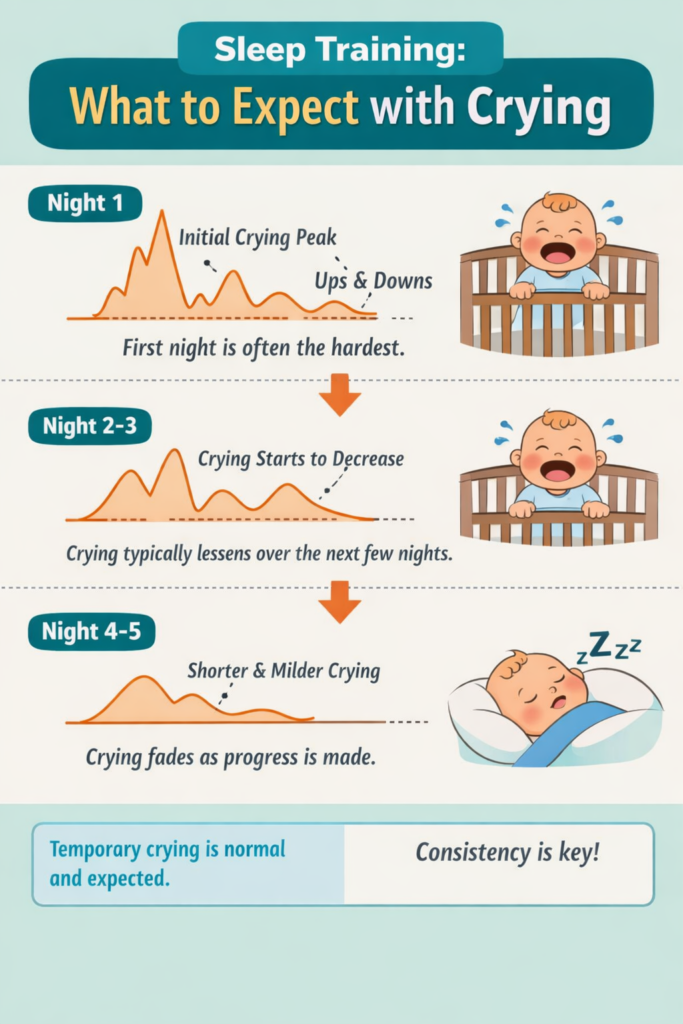
There is no universal number of minutes or nights that defines success. Some babies cry briefly and adapt quickly. Others need more time and support. I call the first 3 nights the wild card nights. I have worked with hundreds of babies now and those first three nights can have such variation between different ages and temperaments.
Progress is best measured by trends over several days—not by a single difficult bedtime. Sleep training, like any new skill, is not linear. It is super normal to have a few nights of success and then a bit of clunkier night in the first week. Success is not zero crying; it is improved sleep, regulation, and well‑being for both baby and parents. However, most babies do get to the point where there is no crying and they build an incredibly
positive relationship with sleep that is not at all associated with frustration.
A Compassionate Reframe: Teaching Sleep Without Guilt
Supporting sleep is an act of care. Babies can cry and still feel safe. Parents can hold boundaries with empathy. Crying is a baby’s only way of communication as they have no words. Making changes can also feel very frustrating, just as it can for adults even. Setting solid boundaries around sleep benefits the entire family. We need sleep to thrive and be well; it’s not a luxury. Establishing healthy sleep training comes with a very short term difficult period that can lead to years of improved health and rest.
At Little Trees Sleep Consulting, gentle sleep training is not about perfection—it’s about being thoughtful, responsive, and consistent. When approached this way, teaching sleep is not something done to a baby, but something done with and for them.
Teresa Sedlmair is the founder of Little Trees Sleep Consulting in Vancouver, BC. She supports families with babies and toddlers across the Lower Mainland and virtually abroad. She works closely with parents to navigate challenges like night wakings, short naps, co-sleeping and various other sleep associations such as rocking and feeding to sleep using practical, evidence based and responsive approaches. She is trusted by over 500 families and has an exclusive 5 star rating.
References
Price AMH, Wake M, Ukoumunne OC, Hiscock H. Five‑year follow‑up of harms and benefits of behavioral infant sleep intervention. Pediatrics. 2012;130(4):643–651.
Gradisar M, Jackson K, Spurrier NJ, et al. Behavioral interventions for infant sleep problems: A randomized controlled trial. Pediatrics. 2016;137(6):e20151486.
Bilgin A, Wolke D. Parental use of “cry it out” in infancy and child attachment and behavior at 18 months. Journal of Child Psychology and Psychiatry. 2020;61(11):1184–1193.