
If your baby is waking every two hours at night, you are not alone—and you’re not doing anything wrong.
This is one of the most common concerns I hear from parents. And while it’s often labeled as “normal,” that explanation rarely tells the full story—especially once your baby is past the newborn stage.
In my experience, and based on the clients I have worked with, waking every two hours is usually not random. There is almost always a clear reason behind it—and once you understand that, things can start to shift.
First—Is It Normal for Babies to Wake Every 2 Hours?
In the newborn stage, yes. It is super normal for newborns and younger babies to wake frequently due to their small stomach size and needing frequent feedings. As well, a newborn’s circadian rhythm isn’t fully developed yet, which further hinders them from consolidating their night.
But around 3.5–4 months old, something important happens:
👉 Your baby’s sleep cycles mature and become more adult-like.
Newborns easily go from light to deep sleep. This is due to the fact that their sleep cycles only have two states. However, once they mature to adult four stage cycles, all bets are off! They come much more fully out of the sleep cycles and are more likely to wake.
I have had countless clients wonder also why they can no longer transfer their baby asleep easily. It’s due to these lighter stages of sleep! Their baby is more aware and alert.
This is a major turning point in sleep—and it’s often when parents suddenly see frequent night waking begin or worsen.
So if your baby is waking every two hours beyond this stage, it’s usually not just “a phase.” This is why I call it the sleep “progression” as opposed to regression. It’s a permanent developmental change. I have worked with numerous older babies where this regression never really resolved. Parent’s share that their baby was sleeping much better until 3-4 months old and then they never really recovered.
The Real Reason: Your Baby Can’t Yet Connect Sleep Cycles
This is the most important piece to actually resolving these wakings and why some parents report that the regression never actually went away.
After sleep cycles mature around 3.5–4 months:
- Babies move through lighter and deeper sleep stages
- They briefly wake at the end of each cycle (which happen to be around 2 hours long)
That part is completely normal.
But here’s where things change:
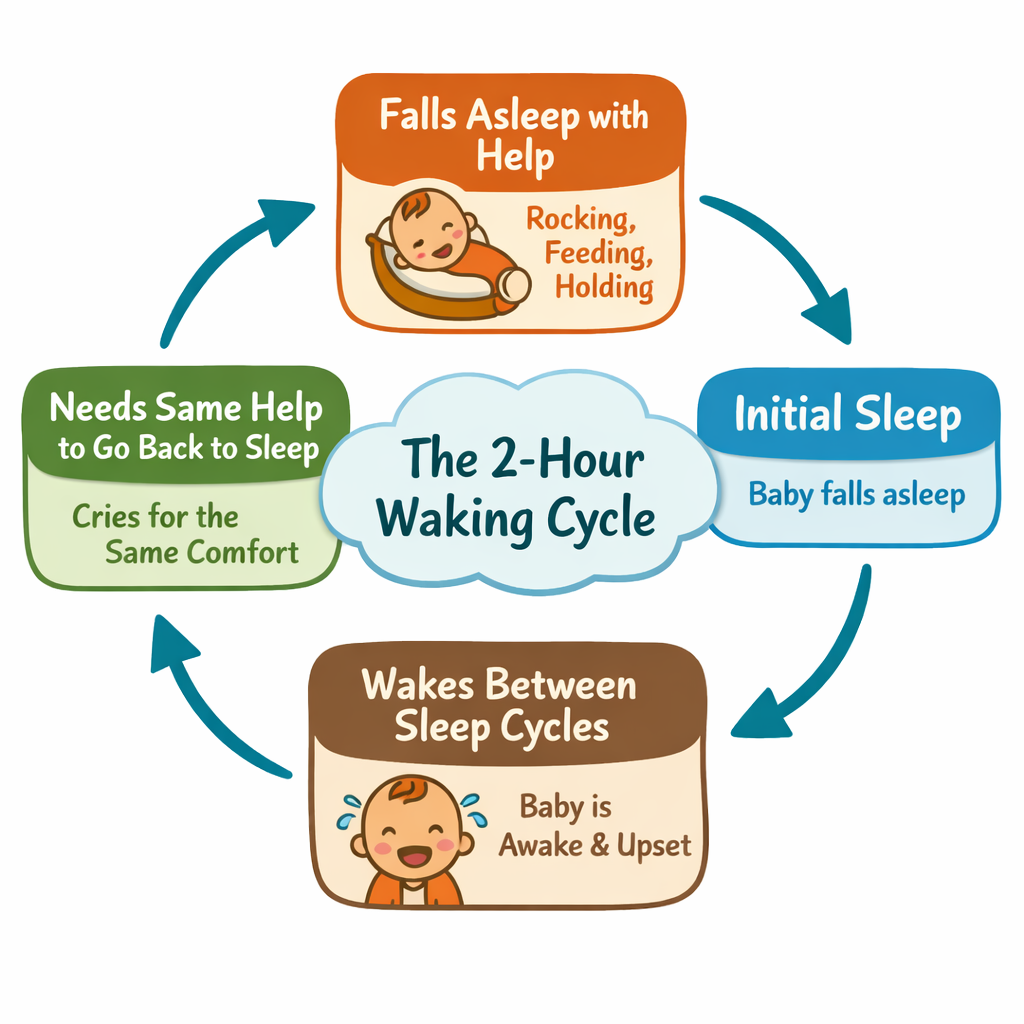
👉 Your baby now needs to know how to fall back asleep between cycles
In my experience, based on the clients I have worked with, babies who wake every two hours are almost always:
- Waking at the end of a sleep cycle
- And don’t yet know how to connect into the next one independently
Where Sleep Associations Come In
This is where things really click for most families.
If your baby falls asleep:
- Feeding
- Rocking
- Being held
- Bounced or soothed
- Needing the pacifier
…then that becomes the expected condition for sleep.
So when they wake between cycles, they’re not confused—they’re consistent with their expectations. It’s the only way they know how to go back to sleep and the existing habits can be strong.
👉 They’re simply thinking:
“This is how I fell asleep. I need the same thing again because I’m awake and I have no idea how to fall back asleep on my own.”
In my experience, this is the primary driver of that predictable 2-hour wake pattern.
Not only that, I find often more sleep associations get introduced during this time out of desperation or that parents think their baby is hungry at every waking. This can set off a reverse cycling pattern. And it’s real.
When a baby is getting a large chunk of their calories in the night, they will inevitably be more distracted and less hungry in the day. I can’t tell you how many clients report distracted eating right when this regression hits. This is where the reinforcing cycle gets set off because now a baby might genuinely start to be hungry in the night.
The Second Big Factor: Not Enough Sleep Pressure
Here’s the part that often gets overlooked.
Many babies waking frequently at night are not overtired—they are actually:
👉 undertired or lacking enough sleep pressure
Sleep pressure is the biological drive to sleep that builds while your baby is awake. Some people think this just comes down to the last wake window of the day or total daytime sleep. However, every single wake window in the day builds up sleep pressure for the night. As well, how often a baby naps, how long each wake window is and how much total day sleep is will effect how easily your baby can consolidate their night and connect their sleep cycles. This is even if your baby knows how to fall asleep independently.
I always say that both halves of the puzzle are needed to eliminate frequent wakings: independent sleep combined with sufficient sleep pressure.
If there isn’t enough sleep pressure:
- Sleep becomes lighter
- Night wakings increase
- Babies fully wake instead of drifting back to sleep after a short wakeful period
Based on the clients I have worked with, I often see:
- Wake windows that are too short
- Too much daytime sleep
- Schedules that don’t match the baby’s actual sleep needs or where they are at developmentally in terms of how often they need to need. A baby only needs a certain amount of sleep in a 24 hour period. If the schedule is expo
This is especially common in:
- Lower sleep needs babies
- Babies who “don’t follow averages”
Other Contributing Factors
While sleep cycles and sleep pressure are the big ones, a few other things can play a role:
Habitual Night Feeding
Some babies continue waking to feed out of habit rather than hunger—especially if feeding is tied closely to falling asleep or reverse cycling is in play.
Daytime Sleep Imbalances
Too much or too little daytime sleep can both lead to fragmented nights.
Sleep Environment
Light, temperature, or inconsistent conditions can make it harder for babies to transition between cycles smoothly.
What Actually Helps
The key is addressing the root cause—not just reacting to the wake-ups or hoping that the sleep cycle maturation passes. This is a permanent change in your baby’s sleep cycles.
1. Support Independent Sleep Skills (Gently)
This can be done by various sleep training methods, depending on your comfort level.
It means helping your baby learn:
👉 how to fall asleep without any sleep association so that they can also fall back asleep in the middle of the night without those needing to be repeated. Please note though, this does not mean all night feedings need to be cut! As I always say, sleep training does not need to mean night weaning. However, most likely, your baby isn’t waking every 2 hours out of hunger.
This will teach your baby to connect their own sleep cycles.
2. Adjust Sleep Pressure
In my experience, this is one of the fastest ways to improve night sleep. The number one phrase I say: half of sleep training, if not more, has nothing to do with the method. Sleep pressure is the ultimate best friends of consolidated, good sleep for babies.
This might mean:
- Extending wake windows
- Adjusting nap lengths
- Dropping a nap
- Looking at total daytime sleep
Small changes here can make a huge difference at night. I can’t tell you how many times clients see significant improvement in their baby’s sleep, even before officially starting the sleep training, just by adjusting the schedule.
3. Create Consistency
Babies thrive on predictability.
- Same bedtime routine
- Same sleep environment
- Same general rhythm each day
This helps their body know what to expect.
When Will It Get Better?
In my experience, once the right pieces are in place:
- Some families see improvement within just a few nights
- Most see meaningful progress within 1–2 weeks
The biggest shift usually happens when:
👉 Baby starts connecting sleep cycles more independently
Final Thoughts
If your baby is waking every two hours, it’s not random—and it’s not something you just have to wait out.
In most cases, it comes down to:
- Sleep cycle changes after 3.5–4 months
- Sleep associations
- Not enough sleep pressure
And the good news is—these are all things that can be gently worked on. This “sleep progression” does not have to last forever. In my experience, making these adjustments can bring quick and life changing results as every 2 hour wakings can quickly become unsustainable. If you need any help from a sleep consultant, don’t hesitate to reach out!
Teresa Sedlmair is the founder of Little Trees Sleep Consulting in Vancouver, BC. She supports families with babies and toddlers in Vancouver, across the Lower Mainland and virtually abroad. She works closely with parents to navigate challenges like night wakings, short naps, co-sleeping and various other sleep associations such as rocking and feeding to sleep using practical, evidence based and responsive approaches. She is trusted by over 600 families and has an exclusive 5 star rating.